
Baseball in Boston is one of the central stories in American baseball. The city is home to the Boston Red Sox, Fenway Park, generations of historic players, one of the sport’s most famous rivalries, and a fan culture that stretches across New England. Boston baseball is not just a local sports category. It is a civic identity, a regional language, and one of the most recognizable baseball traditions in the world.
The Boston baseball story is also larger than the Red Sox alone. The city once had two Major League Baseball teams, with the Boston Braves sharing the market before moving to Milwaukee after the 1952 season. Boston has also been shaped by college baseball, amateur baseball, high school development, summer leagues, neighborhood diamonds, and a long relationship with baseball history, race, memory, and regional loyalty. Few American cities have a baseball identity as dense as Boston’s.
Baseball History in Boston
Baseball history in Boston reaches back to the nineteenth century, when the city became one of the sport’s most important early professional centers. Boston had major professional baseball before the Red Sox existed, and the city’s National League roots are especially important. The franchise that eventually became the Atlanta Braves began in Boston in the nineteenth century and played under several names, including the Boston Red Stockings, Beaneaters, Doves, Rustlers, Braves, Bees, and Braves again. That franchise gave Boston one of baseball’s deepest National League histories before it relocated to Milwaukee in 1953 and later to Atlanta.
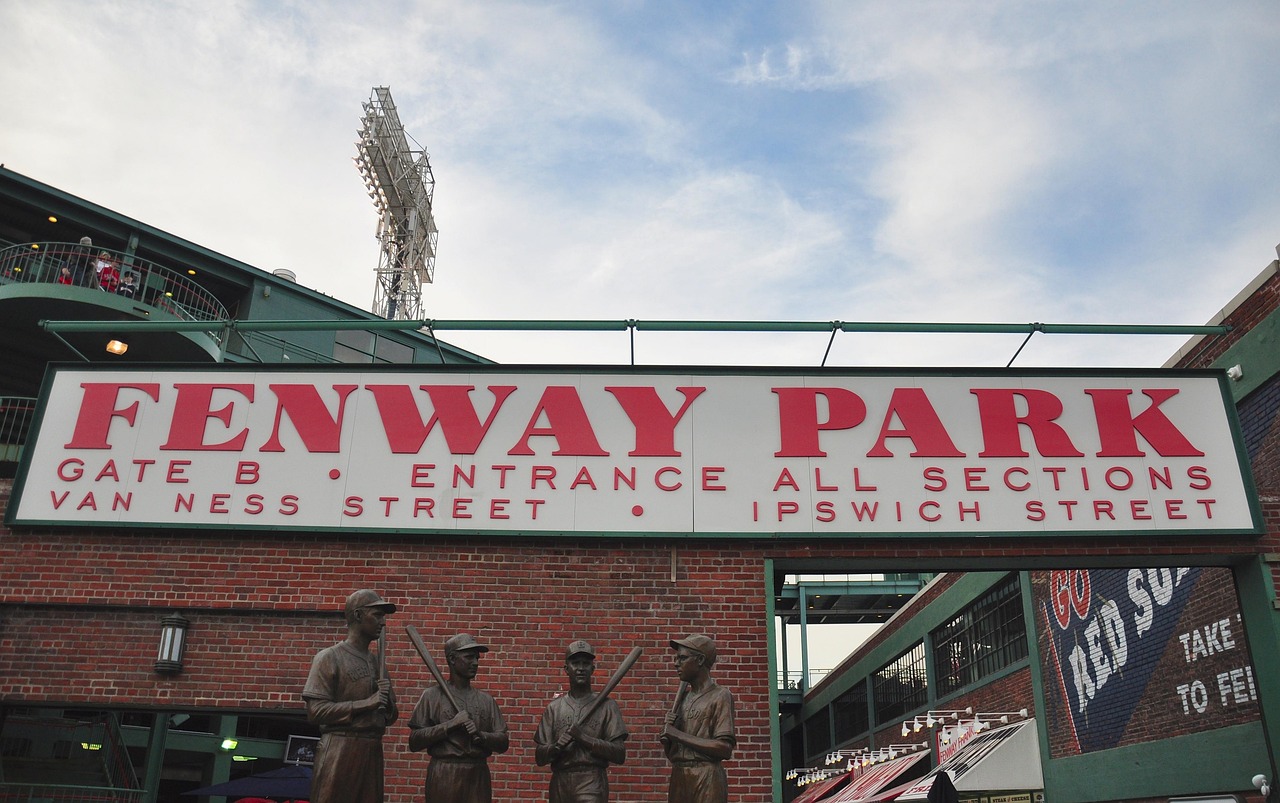
The Red Sox became Boston’s lasting American League identity. Founded as one of the American League’s original franchises in 1901, the team quickly became one of early twentieth-century baseball’s great clubs. Boston won several World Series titles in the 1910s, powered by stars such as Cy Young, Tris Speaker, Harry Hooper, and Babe Ruth. Fenway Park opened in 1912 and became the permanent stage for Red Sox baseball, making Boston one of the few cities where the ballpark itself is almost as famous as the team. The Red Sox describe Fenway Park as having opened on April 20, 1912, making it the oldest active Major League Baseball ballpark.
The sale of Babe Ruth to the New York Yankees after the 1919 season became one of the defining moments in Boston baseball mythology. Ruth had been a star pitcher and emerging slugger for Boston before becoming the central figure in Yankees history. His departure helped fuel decades of Red Sox frustration, Yankees dominance, and one of the most famous rivalries in sports. The “Curse of the Bambino” became a cultural shorthand for Boston’s long World Series drought, even if the phrase simplified a much more complicated baseball history.
Boston’s baseball history also includes painful racial history. The Red Sox were the last MLB team to integrate, and the club’s slow movement toward integration remains a major part of any honest account of Boston baseball. The city’s ballparks also hosted Black baseball and interracial exhibition games before and after Jackie Robinson’s major league debut. Research on Black teams at Fenway Park and Braves Field notes that Black teams played White teams in exhibition games at Boston’s major ballparks between 1938 and 1945, with additional games after the beginning of integration.
The modern Red Sox era changed the city’s baseball identity again. The 2004 World Series title ended the franchise’s 86-year championship drought and became one of the most important moments in Boston sports history. The 2007, 2013, and 2018 titles turned the Red Sox from tragic historic franchise into one of the most successful MLB clubs of the early twenty-first century. That shift did not erase the older mythology, but it changed the emotional language of Boston baseball.
Professional Baseball Teams and Ballparks in Boston
Professional baseball in Boston is centered on the Red Sox and Fenway Park. Fenway is not only a baseball stadium; it is one of the city’s best-known landmarks. The Green Monster in left field, the manual scoreboard, the tight urban footprint, Pesky’s Pole, the right-field corner, and the old ballpark atmosphere all make Fenway one of the most distinctive venues in North American sports.
The Red Sox are one of Major League Baseball’s most valuable and visible franchises. Their identity is tied to New England, not just Boston. Fans travel from Massachusetts, Rhode Island, New Hampshire, Maine, Vermont, Connecticut, and beyond to see the team. NESN, radio broadcasts, local media, and generational fandom have made the Red Sox a regional institution. In many parts of New England, Red Sox fandom is less a choice than a family inheritance.
Boston’s professional baseball history also includes the Braves. Braves Field opened in 1915 and was one of the largest ballparks of its era. The Boston Braves won the 1914 World Series after a famous late-season surge, remembered as the “Miracle Braves.” The franchise remained in Boston through the 1952 season before moving to Milwaukee. The Braves’ departure left the Red Sox as Boston’s only MLB team, but the National League history still matters. Boston is one of the few cities that can claim deep historic roots in both major leagues.
The Red Sox farm system also keeps Boston connected to nearby professional baseball. Worcester is the closest current domestic Red Sox affiliate, and MiLB lists the organization’s current affiliates as the Triple-A Worcester Red Sox, Double-A Portland Sea Dogs, High-A Greenville Drive, and Single-A Salem RidgeYaks. Worcester’s move into the Red Sox system gave Massachusetts a Triple-A club close to Boston, strengthening the connection between Fenway and the development pipeline.
The Boston area has also had independent, summer collegiate, and amateur baseball traditions. The North Shore, South Shore, Cape Cod, and greater New England region provide summer baseball opportunities that connect college players, local fans, and professional scouts. While the Cape Cod Baseball League is outside Boston proper, it is part of the larger Massachusetts baseball ecosystem and strongly connected to the way New England follows amateur baseball.
Boston’s ballpark geography is unusually rich. Fenway is the living monument. Braves Field is the lost diamond. College fields, neighborhood parks, suburban youth complexes, and nearby minor league venues complete the wider map. Together, they make Boston baseball both major-league grand and locally grounded.
College, University, and School Baseball in Boston
College baseball in Boston is important, but it does not dominate the city the way college baseball does in parts of the South, Texas, California, or the Carolinas. Boston is a college city, but its college sports identity is more heavily associated with hockey, basketball, rowing, lacrosse, and academics than baseball. Even so, several important programs keep the college game visible.
Boston College is the most prominent Division I baseball program in the area. The Eagles compete in the Atlantic Coast Conference, one of the strongest baseball conferences in the country. That gives Boston College a high-level schedule and a national recruiting platform. The program has produced major league players and gives the Boston area a connection to elite college baseball competition.
Northeastern is another important local program. The Huskies have built a strong baseball identity within the city and have been one of the better college baseball programs in the Northeast. Northeastern’s location gives it a direct Boston baseball presence, and its success has helped prove that northern college baseball can be competitive despite weather and scheduling disadvantages.
Harvard adds another layer. Ivy League baseball is not the same as ACC or SEC baseball, but Harvard’s history and local presence matter. The program connects Boston-area baseball to one of the country’s oldest university athletic traditions. Other nearby colleges and universities across greater Boston and eastern Massachusetts also contribute to the regional baseball player pool.
Boston University no longer sponsors varsity baseball, which is a reminder that college baseball in the Northeast often faces institutional and climate challenges. Short outdoor seasons, facility limitations, travel costs, and competition with other sports can make college baseball harder to sustain in urban northern settings.
High school baseball in greater Boston remains important. The city and surrounding suburbs produce players through public schools, private schools, Catholic schools, club programs, travel teams, and summer leagues. Massachusetts players often face a shorter outdoor season than athletes in Florida, Texas, Georgia, Arizona, or California, so indoor training, winter workouts, and summer competition become critical.
The Boston baseball development pathway is therefore different from warm-weather baseball markets. Players often develop through a combination of high school baseball, travel programs, summer leagues, showcase events, college recruiting, and indoor facilities. The best players may move into Division I baseball, Division II or Division III programs, junior college routes, or professional scouting opportunities. Boston does not produce baseball talent by volume like some Sun Belt markets, but it has a serious and competitive regional development system.
Baseball Players from Boston
Boston has been connected to many great baseball players, but it is important to distinguish between players born in Boston, players who starred for Boston teams, and players who became part of Boston baseball culture. The city’s baseball identity is built from all three categories.
Red Sox legends form the most visible group. Ted Williams is one of the greatest hitters in baseball history and remains one of Boston’s defining athletes. Carl Yastrzemski carried the Red Sox through the 1967 “Impossible Dream” season and became a symbol of loyalty and endurance. Jim Rice, Carlton Fisk, Pedro Martínez, David Ortiz, Dustin Pedroia, Manny Ramirez, Nomar Garciaparra, Roger Clemens, Wade Boggs, Dwight Evans, Luis Tiant, Mookie Betts, and many others are central to the Red Sox memory bank.
Babe Ruth belongs to both Boston and New York baseball history. In Boston, he was a brilliant left-handed pitcher and emerging offensive force. In New York, he became the most famous slugger in baseball history. His move from the Red Sox to the Yankees permanently shaped how Boston fans understood success, regret, rivalry, and history.
The Boston Braves also produced and hosted major figures. Warren Spahn, Eddie Mathews, Johnny Sain, Rabbit Maranville, and other Braves-connected players belong to Boston’s older National League story. Even though the Braves later became identified with Milwaukee and Atlanta, their Boston years remain part of the city’s baseball heritage.
Boston-area player development includes athletes from the city, suburbs, and wider Massachusetts region. The exact definition of “from Boston” can vary. Some players were born in the city. Some grew up in nearby towns. Some played high school or college baseball in the region. Some became Boston baseball figures because of what they did at Fenway rather than where they were born.
This distinction matters for SEO and accuracy. A page about baseball in Boston should include Red Sox legends because they define the city’s baseball culture, but a separate “baseball players from Boston” article would need to be stricter about birthplace and development. The landing page can balance both: Boston as a place that produces players, and Boston as a place where players become legends.
Baseball Culture and Regional Identity in Boston
Baseball culture in Boston is intense, historical, and deeply regional. The Red Sox are one of the core institutions of New England identity. Fans do not only follow the team through wins and losses; they inherit stories, grievances, favorite players, family rituals, and arguments about eras. Boston baseball is built on memory.
The Yankees rivalry remains one of the central emotional structures of Boston sports. Red Sox-Yankees games carry a different charge because the rivalry includes geography, class, media markets, franchise history, championships, collapse, comeback, and decades of fan storytelling. The 2004 American League Championship Series, when Boston came back from a three-games-to-none deficit against New York, became the defining modern rivalry moment.
Fenway Park is the center of the culture. Many cities have beloved ballparks, but Fenway’s role in Boston is unusually powerful because the stadium sits inside the city fabric. It is not a distant suburban venue surrounded only by parking lots. It is part of a neighborhood, connected to bars, restaurants, streets, universities, hospitals, apartments, and transit. The walk to Fenway is part of the experience.
Boston baseball culture is also argumentative. Fans debate front offices, ownership, payroll, prospects, media narratives, trades, player development, and roster construction with unusual intensity. The city’s sports media environment amplifies that scrutiny. Baseball in Boston is not background entertainment; it is examined daily.
At the same time, Boston baseball culture has had to reckon with its own exclusions. The Red Sox’s late integration and the experiences of Black players in Boston remain part of the city’s baseball history. Any serious account of Boston baseball has to include both the romance of Fenway and the harder parts of the city’s sporting past.
The regional reach of the Red Sox is another defining feature. In much of New England, the Red Sox are the baseball team. That creates a market identity different from cities with multiple nearby MLB loyalties. Boston’s baseball influence extends into Maine, New Hampshire, Vermont, Rhode Island, and parts of Connecticut, though Connecticut also has Yankees and Mets influence. That regional map gives Boston one of the strongest non-statewide baseball identities in the country.
The Future of Baseball in Boston
The future of baseball in Boston depends on the Red Sox remaining competitive, Fenway staying viable as a historic ballpark, and the region continuing to develop young players despite northern-weather challenges. Boston is not in danger of losing its baseball identity. The deeper question is how that identity evolves in a sports market that also includes the Celtics, Patriots, Bruins, Revolution, college hockey, college basketball, and growing interest in soccer and women’s sports.
Fenway Park will remain central. Its age is part of its appeal, but it also requires constant maintenance and modernization. The Red Sox have managed to preserve Fenway while adapting it for contemporary fans, and that balance will continue to shape Boston baseball.
The player-development future is more complex. Greater Boston has strong athletes, strong schools, indoor training facilities, and competitive travel programs, but baseball access can be expensive. If the sport becomes too dependent on private instruction and showcase circuits, it risks narrowing the local player pool. Strong public school programs, community leagues, affordable youth baseball, and summer competition will remain important.
Boston’s college baseball future also matters. Boston College and Northeastern give the region high-level college programs. Harvard and other local schools add depth. Continued investment in college facilities, scheduling, recruiting, and player development can help the city remain relevant in northern baseball.
Baseball in Boston is already one of the sport’s great city stories. Its future is not about inventing an identity. It is about sustaining one: Red Sox baseball at Fenway, college and high school development across the region, minor league connections through Worcester and New England, and a fan culture that still treats baseball as part of the city’s civic memory.




Interested in Sports in Boston?
American Football in Boston | Basketball in Boston | Cricket in Boston | Football (Soccer) in Boston | Hockey in Boston | Rugby in Boston